The Drop from O2
Client
O2
Industry
Telco
Category
CRM programme, email, social
You can tell how much an editorial programme is trusted by who gets handed it. The Drop was already up and running when O2 asked us to take it over, on the basis we were the people most likely to make it better. I led that work.
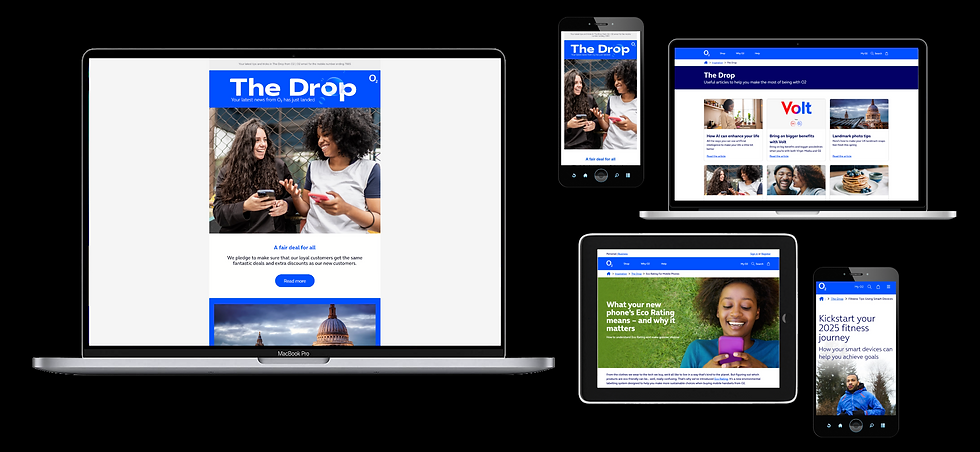
The Drop is O2’s monthly engagement programme, an email and website CRM product that shows customers the best of what their plan offers and, in doing so, drives NPS and customer retention and engagement. If that sounds familiar, it should: it is O2’s counterpart to Virgin Media Edit, the programme I lead on the other side of the merged business. But it is not a copy. The Drop is monthly rather than weekly, far more driven by brand briefs and built for a base segmented by plan type and marketing consent.
We did not launch it. We were brought in shortly after launch because we were already producing editorialised brand content at scale and were judged the safest hands to push the programme forward. From that point, I owned the full production: planning and ideating the content, writing and editing the articles, building the emails, writing and testing the subject lines and producing the dedicated My O2 app tile that runs alongside each issue, all in collaboration with the client and my editorial team.
The foundation was the newsroom model I had refined for Virgin Media Edit, but O2 came with its own constraints, and working within them was most of the job. Due to website access limits on O2’s site, everything runs through their digital team on a much longer lead time, which makes the programme far less reactive than The Edit. I leaned into seasonal planning and evergreen content to keep it feeling timely, and treated The Drop as a more broadcast product, built around a tight monthly article limit rather than a constant feed.
What kept it improving was research. I consistently analysed email and content engagement to map what customers genuinely cared about, which put scams, cost of living, saving money and perks at the top, and showed that framing mattered as much as subject: a benefit called out in the headline consistently beat the same story buried in the copy. We folded in O2’s own customer research, ran continuous subject-line testing built on hard-won learnings from The Edit and tested personalised against plain subject lines to find what each segment actually responded to.
At the end of 2023, I also worked with O2’s digital team to replace the rigid, image-heavy article template with a flexible single-column layout, so the content could finally read like editorial rather than a stack of modules. We also redesigned the email in line with O2’s new brand guidelines.
The clearest proof came from the customers nobody could reach. We built a re-engagement campaign aimed squarely at people who had never once opened The Drop, and it pulled measurable opens and clicks out of a base that had been written off, enough to change how we planned later sends.
What the work delivered:
-
A monthly, segmented email and website programme for O2’s customer base, taken over post-launch and run end to end
-
4-6 articles a month, plus emails, subject lines, social and a dedicated My O2 app tile
-
A content strategy rebuilt regularly based on engagement analysis of the programme’s own performance
-
A new, flexible website template, built with O2’s digital team to replace the original rigid one
-
A new look and feel for the email
-
A re-engagement campaign that won opens and clicks from customers who had never once opened the email
What it shows: being trusted to take over and improve an established CRM programme – adapting a proven newsroom model to a new brand’s constraints, and using research and editorial judgement to keep lifting engagement.